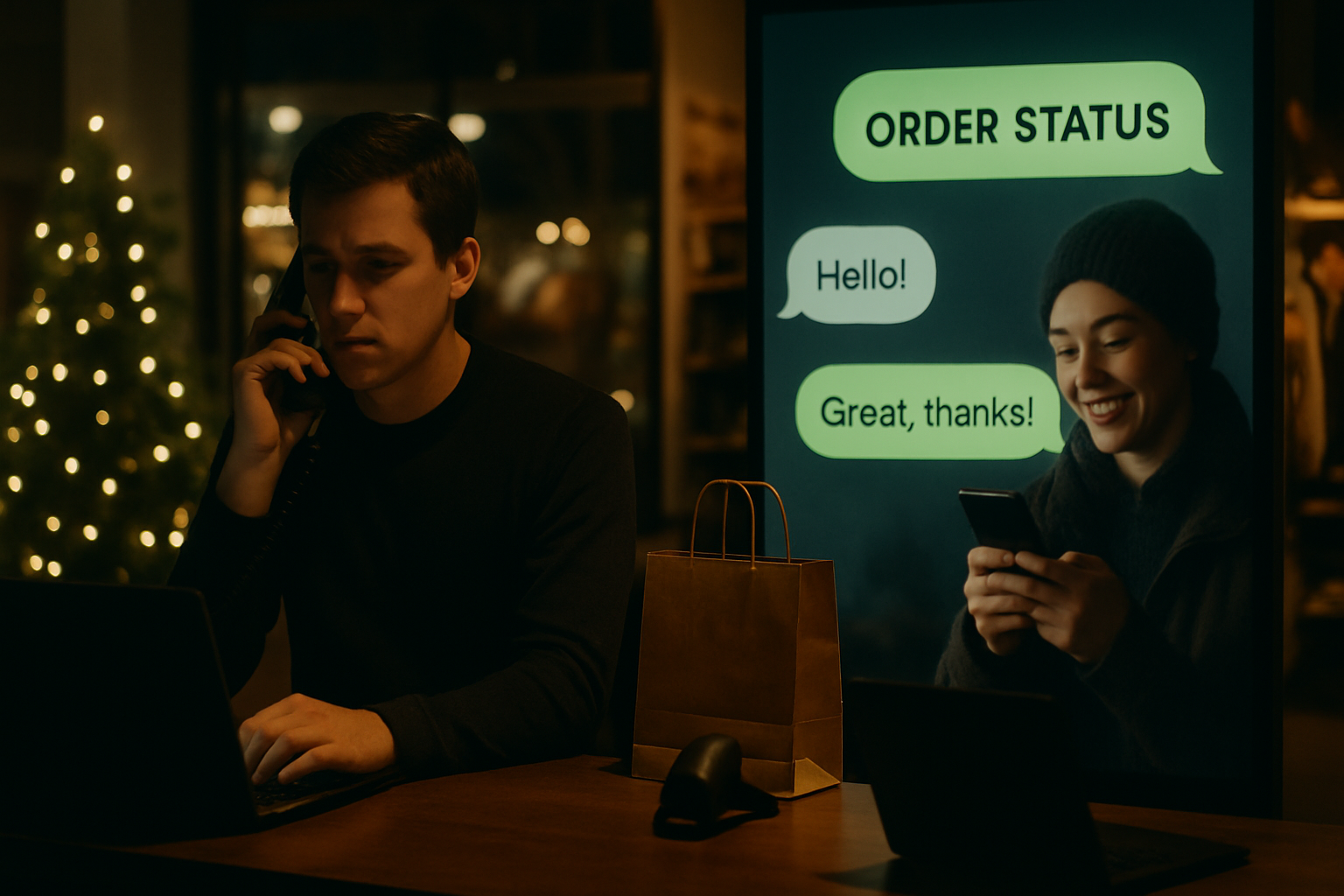
Holiday prep usually exposes the same customer communication problem in Colorado Springs. The phone rings with five kinds of conversations mixed together, but only two or three of them truly need a live call. A retail store gets hit with order-status questions and pickup timing. A healthcare office is juggling appointment confirmations and simple reminders, but also conversations that should stay on voice because they involve explanation, privacy, or clinical nuance. That is where business texting Colorado Springs teams are considering can help, if they set the boundaries correctly.
Businesses should use text messaging instead of phone calls when the exchange is short, routine, and easy to answer without back-and-forth explanation. Phone calls should stay in place for sensitive, complex, urgent, or emotionally charged conversations, especially in healthcare. The right split is not text versus voice. It is deciding which customer interactions belong in each channel and making sure the texting side is managed, shared, and compliant.
When should a business use text messaging instead of phone calls with customers?
Use text messaging for short exchanges with a clear purpose, and keep phone calls for anything that needs context, reassurance, troubleshooting, or private discussion. In practice, that means a holiday order-status question may fit text perfectly, while a changed medical appointment with prep instructions may start with text but often belongs on a call.
I tell owners the same thing all the time. Do not start with the phone system feature list. Start with the actual conversations your staff had yesterday.
A workable decision rule looks like this:
- Move it to text if the customer is asking for a status update, confirmation, arrival window, basic scheduling response, or a one-line answer.
- Keep it on voice if the customer needs an explanation, has multiple questions, is upset, is discussing money in detail, or the topic includes sensitive health information.
- Use both when text handles the first step, such as “Please confirm your appointment,” but staff can quickly move the exchange to a call if the customer replies with confusion or a special circumstance.
That distinction matters more during November and December, when Colorado Springs businesses feel the pressure of holiday demand, year-end staffing limits, and weather interruptions at the same time.
In Colorado Springs, holiday traffic, winter weather, and year-end schedule compression all hit at once. A store near Powers or a medical office serving patients from Monument to Security-Widefield may see simple customer questions spike on the same days staff availability tightens. That is exactly when separating “quick text” conversations from “this needs a call” becomes operationally useful.
What does the retail version of business texting Colorado Springs stores need look like?
Retail usually has more routine customer contacts that can move to text safely and cleanly. A store answering order-status, pickup timing, or in-stock follow-ups can often shift a meaningful share of those short exchanges away from voice without trying to replace customer calls.
Imagine a Colorado Springs retailer in December handling 120 customer contacts a day. If even 35 of those are “Is my order ready?” or “What time can I pick it up?”, those are text-shaped conversations:
| Retail interaction | Best channel | Why |
|---|---|---|
| “Is order #48192 ready?” | Text | Short answer, clear record, no explanation needed |
| “Can I pick it up at 4:30?” | Text | Simple confirmation |
| “My order is missing an item. What happened?” | Usually call | Needs discussion, problem solving, possibly emotion |
| “I need help choosing the right model.” | Call | Advice and clarification matter |
The point is not that every store should force customers into texting. The point is that some repeat interactions are wasting staff time on voice when a managed text thread would be faster for both sides.
There is also a customer preference angle. According to Pew Research Center, texting is one of the most common ways people use their phones across age groups. That does not prove every customer wants every business interaction by SMS, but it does support the practical reality most owners already see. Many customers are comfortable sending a short text for a short need.
What retail boundaries should stay in place?
Retail texting should stay narrow enough that staff can answer consistently and customers are not left waiting on a long thread. Good boundaries protect the customer experience and keep ownership clear.
- Use text for status, timing, basic availability, and pickup coordination.
- Move returns disputes, damaged-order complaints, financing questions, and detailed product guidance to voice.
- Keep one shared business-owned number or inbox, not employee personal phones.
- Document who responds during business hours and what happens after hours.
If the current setup is still being evaluated, the bigger question is not “can it send SMS?” but whether the system supports managed use by multiple staff members. That is part of what we help businesses review at QuByte Systems, especially when the owner wants a vendor-neutral answer instead of a phone sale.
Common mistake: treating business texting like a personal phone habit
The weak version is one employee texting customers from a cell phone nobody else can see, manage, or audit. The stronger version is a shared, business-owned texting workflow with visible history, clear response rules, opt-out handling, and a handoff path to voice when the conversation stops being simple.
Why does a healthcare office need tighter texting boundaries than a retailer?
Healthcare can absolutely use texting for certain administrative contacts, but the boundaries need to be narrower because privacy, context, and patient confusion matter more. Appointment confirmations often fit SMS. Clinical explanations, symptoms, billing detail, and anything involving protected health information usually do not.
Here is the healthcare version of the same comparison. Picture a Colorado Springs medical office confirming 60 appointments a day in the weeks around Thanksgiving and year-end. Some exchanges belong in text:
| Healthcare interaction | Best channel | Why |
|---|---|---|
| “Please confirm your 9:00 AM appointment tomorrow. Reply C to confirm.” | Text | Administrative, short, low ambiguity |
| “We need to reschedule. Please call us.” | Text leading to call | Useful prompt, but discussion should move to voice |
| “Do I need to fast before this test?” | Usually call | Instructions can affect care and may need clarification |
| “I am having new symptoms after treatment.” | Call | Sensitive, urgent, clinically important |
This is where buyers need to stop and think carefully about privacy capabilities, not just convenience. The U.S. Department of Health and Human Services explains that HIPAA-regulated communication decisions depend on how protected health information is handled, what safeguards are in place, and what the patient has agreed to receive. In plain English, a healthcare office should be very careful about what content goes into a text message and what platform is carrying it.
I am blunt on this point with medical clients. If a texting tool makes it easy for staff to casually send patient details that should not be in SMS, it is the wrong tool no matter how attractive the price is.
What should a healthcare office verify before using SMS?
Healthcare offices should verify consent practices, message content limits, auditability, and privacy controls before enabling texting. Administrative convenience is not enough.
- Define which message types are allowed. Appointment confirmations and simple reminders may be allowed. Clinical detail may not be.
- Confirm how patient consent is captured and recorded.
- Make sure opt-out language and handling are in place.
- Verify that multiple authorized staff can access the conversation history.
- Check whether the platform and workflow fit HIPAA obligations, including business associate considerations where applicable.
The Centers for Medicare & Medicaid Services has long emphasized appointment adherence as an operational and care issue, which is one reason confirmations and reminders are so common. But confirming a visit is not the same as discussing treatment by text.
Myth: If customers like texting, most customer communication should move to SMS during the holiday rush.
Reality: Texting works best for routine, brief exchanges with clear boundaries. It does not replace calls that need explanation, empathy, privacy, or decision-making. For healthcare in particular, the wrong text content can create privacy and compliance problems faster than it saves time.
What shared-number ownership, consent, and opt-out rules matter most?
The most important rules are simple: the number should belong to the business, not an employee; customers should clearly consent to receive texts; and opting out should be easy and honored. If any of those three are missing, the texting program is not mature enough yet.
For both retail and healthcare, I recommend owners ask these questions before turning anything on:
Managed texting checklist
- Is the texting number owned by the business and recoverable if an employee leaves?
- Can 2 to 6 staff members share access without passing around one phone?
- Is there a visible conversation history?
- How is customer consent captured at point of sale, online, or during intake?
- How is opt-out handled, and does the system stop future nonessential texts?
- Can staff tell when a conversation should be moved to a call?
- For healthcare, are privacy and message-content limits clearly documented?
Consent and opt-out expectations are not optional details. The Federal Communications Commission provides consumer-facing guidance around unwanted texts and messaging protections. A business does not need to turn this into a legal seminar, but it does need a clean process. Customers should know they are agreeing to receive texts, and they should be able to stop them.
Shared ownership also matters for continuity. If your holiday retail coordinator quits on December 18 or your front-desk lead is out sick after a January snow event, customer conversations cannot disappear with one person’s device.
How do you tell whether your current phone setup can support properly managed texting?
Check for management and accountability first, not marketing claims. A phone system can technically “do SMS” and still be a bad fit if messages live on one handset, lack shared visibility, or cannot be governed by role.
This is the short list I would verify:
- Business-owned number support
- Shared inbox or multi-user visibility
- Message retention and search
- Role-based access
- Opt-out handling
- Clear separation between standard SMS use and protected healthcare workflows
If you are already evaluating a phone refresh, my advice is the same as in this piece on testing the customer call path before approving a Q4 phone purchase. Map the real customer interactions first, then decide what the system needs to support. Do not buy based on a demo alone.
And if your concern is resilience during Colorado weather or provider trouble, verify the communication path itself before you count on it. We covered that in our article on what Colorado Springs businesses should verify about phone-system failover during an internet outage. A texting plan that fails the first time your connection gets shaky is not much of a plan.
"The right question is not 'should we add texting?' It is 'which customer conversations become better by text, and which ones become riskier?'"
That is how I approach business texting Colorado Springs companies ask us about. Vendor-neutral, conversation first, and honest about what should stay on voice.
Need help deciding which customer conversations should be text and which should stay calls?
If you are preparing your Colorado Springs retail or healthcare team for holiday demand, QuByte Systems can review your current or proposed phone setup and tell you whether it supports properly managed business texting, shared ownership, and the right privacy boundaries. Beyond IT support. Engineering what comes next.
Book a discovery call